Passive income with Amazon means building income streams that keep paying you after the heavy lifting is done. The most popular Routes are Amazon Associates, Kindle Direct Publishing (KDP), Merch on Demand, Amazon FBA, the Amazon Influencer Program, audiobook publishing through ACX/Audible, and selling digital products that complement Amazon listings. None of these are truly “set it and forget it,” but several can generate real recurring income once you’ve put in the upfront work.
Why More People Are Turning to Amazon for Passive Income
Relying on a single paycheck feels riskier than it used to, which is why so many people are building income streams that keep earning long after the initial effort is over.Amazon is one of the largest Marketplaces on the planet, with hundreds of millions of customers shopping on it every month.
That scale and trust is exactly why it’s become a launchpad for beginners, creators, and Entrepreneurs who want to earn without inventing a brand-new product or launching a full company from scratch. Whether you’re a student, a freelancer, a blogger, or someone just looking to diversify your income, there’s an Amazon-based option that fits your budget and skill level.
Is Passive Income with Amazon Really Passive?
yes, but with realistic expectations. No online income stream runs itself from day one. Writing a book, designing a product, building a storefront, or setting up a store all take real work up front. What changes is what happens after that work is done many of these Methods keep generating income with relatively little ongoing effort.
A better way to think about it: passive income isn’t “money for nothing.” It’s “money today, for work you already did.”
Amazon Passive Income Methods at a Glance
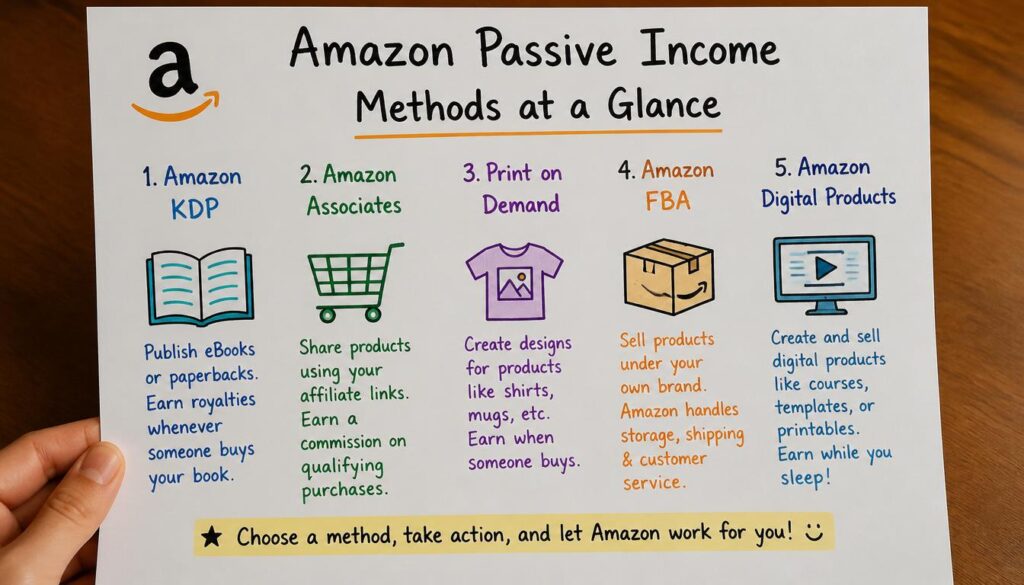
1. Amazon Associates (Affiliate Marketing)
Best for: Bloggers, website owners, YouTubers, Pinterest creators, email marketers.
This is generally the easiest entry point into Amazon passive income. You’re not building or shipping anything you’re Recommending products Amazon already sells, and earning a commission when someone buys through your link.
Say you run a blog about home offices. You could recommend Desks, Monitors, and chairs, and Earn a small commission on every sale that comes through your links.
How it works:
- Join Amazon Associates.
- Pick a niche.
- Publish genuinely helpful content.
- Add Affiliate links naturally, where they Actually help the reader.
- Earn commissions on Qualifying purchases.
Pro tips:
- Solve a real problem instead of just listing products.
- Write detailed buying guides and comparisons.
- Update older content as products and prices change.
- Target specific, lower-competition search terms rather than broad ones.
Why it works: People already trust Amazon to deliver. If your content actually answers the question someone’s searching for, it can keep earning commissions for months or years with almost no extra work.
A note on numbers: Amazon’s commission rates vary by product category and change from time to time, so it’s worth checking Amazon’s current rate card rather than assuming a fixed percentage.
2. Publish Books with Amazon KDP
Kindle Direct Publishing lets anyone self publish ebooks and paperbacks without going through a traditional publisher. You write the book once; Amazon handles printing (for paperbacks), delivery, and payment processing. Every sale earns you a royalty.
Popular book ideas:
- Journals and planners
- Coloring books
- Recipe books
- Children’s books
- Educational or how to guides
- Budget planners and fitness trackers
Advantages
- No inventory to manage
- A built-in global audience
- Low startup cost
- Royalties on every sale
- Print-on-demand, so nothing gets printed until it’s bought
Worth knowing: the “low-content book” niche (blank journals, simple planners) is far more crowded than it was a few years ago. Books that offer genuine originality or expertise tend to hold up better long-term.
3. Sell Custom Designs with Amazon Merch on Demand
If you can design, Merch on Demand lets you upload artwork for T-shirts, Hoodies, tote bags, and phone cases. Amazon prints, ships, and handles customer service you earn a royalty on each sale.
Popular design niches: funny quotes, pet lovers, fitness, teachers, Nurses, gaming, holidays, family gifts, motivational sayings.
Tips for success:
- Research keywords buyers are actually searching for.
- Favor evergreen designs over trend-chasing ones.
- Upload consistently rather than in one burst.
- Write clear, keyword-relevant titles and descriptions.
- Avoid trademarked phrases or copyrighted artwork Amazon will reject or remove these, and repeat issues can get your account suspended.
4. Build an Amazon Influencer Storefront
If you already have an Audience on YouTube, Instagram, TikTok, or Facebook, the Amazon Influencer Program lets you build a storefront of your favorite products, organized into shoppable collections no need to drop a fresh affiliate link into every single post.
Good storefront categories: home Office essentials, Tech gadgets, Beauty products, camera gear, fitness equipment, Travel accessories, kitchen tools, study supplies.
Example: a fitness creator might organize collections like “Home Gym Equipment,” “Healthy Kitchen Products,” “Running Accessories,” and “Workout Recovery Tools.” As new followers discover the content, the storefront keeps earning commissions in the background.
5. Build Passive Income with Amazon FBA
Fulfillment by Amazon (FBA) lets you sell physical products while Amazon stores your inventory, ships orders, handles returns, and manages customer service. It takes more capital up front than affiliate marketing or KDP, but the ceiling is higher.
Unlike dropshipping, FBA lets you build an actual brand around your product. Once your listing is live and optimized, Amazon takes over most of the fulfillment work.
How it works:
- Research a product with real demand.
- Source it from a manufacturer or wholesaler.
- Ship inventory to an Amazon warehouse.
- Create and optimize your product listing.
- Amazon stores, packs, and ships orders as they come in.
- You collect profit after Amazon’s fees.
Strong product categories:
| Category | Competition | Profit Potential |
|---|---|---|
| Home & Kitchen | Medium | High |
| Pet Supplies | Medium | High |
| Office Products | Low | Medium |
| Baby Products | High | High |
| Fitness Accessories | Medium | High |
| Car Accessories | Medium | Medium |
Pros: Amazon handles fulfillment, Prime eligibility attracts more buyers, real long-term brand potential, and generally the highest income ceiling on this list.
Cons: higher startup costs, inventory risk, tougher competition, and ongoing work to manage stock, pricing, and reviews. FBA is the least “hands-off” method here it’s better described as semi-passive than fully passive.
Expert tip: start with a small, focused product line that solves one specific problem well, rather than competing head on with big brands on generic items.
6. Publish Audiobooks Through ACX/Audible
If you’ve already written a book or plan to publish one through KDP turning it into an audiobook is a natural next step. Audiobooks for independent authors are typically produced and distributed through ACX (Audiobook Creation Exchange), Amazon’s platform for getting titles onto Audible, Amazon, and iTunes. Publish once, and you can earn royalties every time someone buys or listens.
Popular audiobook categories: self improvement, personal finance, productivity, business, fiction, children’s books, language learning.
Why it works: a lot of people prefer listening while commuting, exercising, or doing chores. Offering your content in audio as well as text expands your audience and adds a second royalty stream from the same underlying work.
7. Sell Handmade Products on Amazon Handmade
If you make things by hand, Amazon Handmade puts you in front of shoppers specifically looking for artisan, one of a kind items.
Popular categories: jewelry, home décor, candles, leather goods, wooden crafts, personalized gifts, wedding accessories.
This is the least passive method on the list, since you’re still making the product. That said, bringing on production help or streamlining your process as orders grow can make it more scalable over time.
8. Create Digital Resources That Support Amazon Products
Amazon doesn’t sell every kind of digital product directly, but you can still build passive income by creating digital resources that pair naturally with things people buy on Amazon.
Examples: printable planners, study guides, recipe books, workout trackers, budget templates, business checklists.
You can then recommend related Amazon products through affiliate links inside that content (staying within Amazon Associates’ rules), which stacks two income streams on top of a single piece of content.
9. Create Evergreen Content Around Amazon Products
One of the most reliable long-term strategies is publishing content that stays useful — and keeps ranking in search — for years, not weeks.
Examples: “Best laptops for students,” “Best office chairs for back pain,” “Best kitchen gadgets,” “Best camping equipment,” “Best books for entrepreneurs.”
Content formats that tend to work well: buying guides, product comparisons, honest reviews, “best of” roundups, beginner tutorials, and seasonal gift guides.
10. Combine Multiple Amazon Income Streams
Most people who do well with this don’t rely on just one program — they stack several.
A common combination:
| Income Source | Relative Monthly Potential |
|---|---|
| Amazon Associates | $ |
| Amazon KDP | $–$$ |
| Merch on Demand | $ |
| Amazon Influencer Program | $–$$ |
| FBA | $$–$$$ |
Actual results vary enormously by niche, effort, and consistency — treat this as a rough sense of relative scale, not a promise. Diversifying across a couple of these methods tends to smooth out the ups and downs and creates more stable income overall.
Common Mistakes to Avoid
1. Expecting instant results. Passive income takes time to build. Consistency beats chasing overnight wins.
2. Picking an overly broad niche. Instead of trying to cover “everything on Amazon,” specialize home office gear, pet supplies, or fitness accessories, for example.
3. Ignoring SEO. Great content that no one finds doesn’t earn anything. Research keywords, write clear headings, craft real meta descriptions, and keep your pages fast.
4. Publishing thin content. Short, generic articles rarely rank. Aim for real value: practical examples, comparison tables, and insights someone can’t get from a five-second skim of a product page.
5. Breaking Amazon Associates’ rules. Always follow the current Operating Agreement, disclose your affiliate relationship clearly, and avoid misleading claims about products.
Expert Tips for Long-Term Success
- Pick one Amazon income method and get genuinely good at it before adding more.
- Prioritize evergreen content over anything trend-dependent.
- Build an email list so you’re not fully dependent on search traffic.
- Revisit and update older content as products, prices, and rankings shift.
- Use your own original images and screenshots where you can.
- Track which pages actually convert, and put your energy into improving those.
Quick Action Plan for Beginners
- Choose one niche you’re genuinely interested in.
- Set up a website or content platform.
- Join Amazon Associates or KDP.
- Publish helpful, SEO-optimized content consistently.
- Build trust with your audience over time.
- Track your results and double down on what’s working.
- Expand into additional Amazon income streams once your first one is solid.
Frequently Asked Questions
1. What’s the easiest way to start passive income with Amazon? Amazon Associates (affiliate marketing) is generally the easiest starting point. No inventory, no products of your own just helpful content and honest recommendations.
2. How much can beginners actually earn? It depends heavily on your method, niche, and consistency, and there’s no guaranteed number. Affiliate income, KDP royalties, Merch on Demand payouts, and FBA profits can all range from a few dollars a month to a full-time income but most people start small and grow gradually. Be skeptical of anyone promising a fixed dollar figure.
3. Is Amazon FBA truly passive? Not completely. Amazon handles storage, packing, shipping, and customer service, but you’re still responsible for inventory planning, pricing, and keeping your listing competitive.
4. Can I start without investing money? Yes, largely. Amazon Associates and KDP (for ebooks) can be started with little to no upfront cash if you already have the skills or time to create content.
5. Do I need a website for Amazon Associates? It’s recommended, since it gives you full control over your content and SEO but Amazon also accepts applications from qualifying YouTube channels, apps, and certain social platforms.
6. Which method is best for beginners? Amazon Associates, KDP, and Merch on Demand are the most common starting points thanks to their low cost and simpler learning curve compared to FBA.
7. How long before I see real income? Many people see their first sale or commission within weeks, but building something consistent usually takes several months to a year of steady publishing and refining.
8. Is Amazon KDP still worth it in 2026? Yes, for authors who publish genuinely useful, well-targeted books. The low-content book space (blank planners, simple journals) is far more saturated than it used to be, so originality and quality matter more than ever.
9. Can I combine multiple Amazon programs? Yes many creators run Associates, KDP, Merch on Demand, and FBA side by side to diversify their income and reduce reliance on any single source.
10. What skills actually help? Basic SEO, content writing, keyword research, product research, email marketing, and reading your own analytics. Graphic design helps for Merch on Demand but isn’t required elsewhere. Most of these can be learned free online.
Final Thoughts
Passive income with Amazon isn’t a shortcut it’s the payoff from building assets that keep working after you’ve moved on to the next thing. Whichever path you pick Associates, KDP, Merch on Demand, or FBA the common thread among people who succeed is that they solve a real problem for real customers and stay consistent long enough to see it compound. Rather than spreading yourself across every method at once.
pick one, learn it properly, and improve it steadily. Once that’s working, expanding into a second or third stream gets a lot easier. The best time to start was a year ago. The next best time is today.